

Productivity is not about always doing more, but about freeing up time and completing what truly matters to you.
1 | Intentions
Our intentions, or our why, for this block were to
Create time and space for what truly matters
Take action on projects that we deeply care about
… optimally not only for this month, but for the next 20 years. While it has been difficult to always take action on projects that we deeply care about, one thing has become really apparent during the month: by simply defining what the next step of each action is and listing it all in one centralized space (more on that in the sections below), it has had a profound effect on de-cluttering our minds, including a vast decrease in overall pressure and stress felt, as well as our ability to focus on the one action in front of us.
2 | Quest
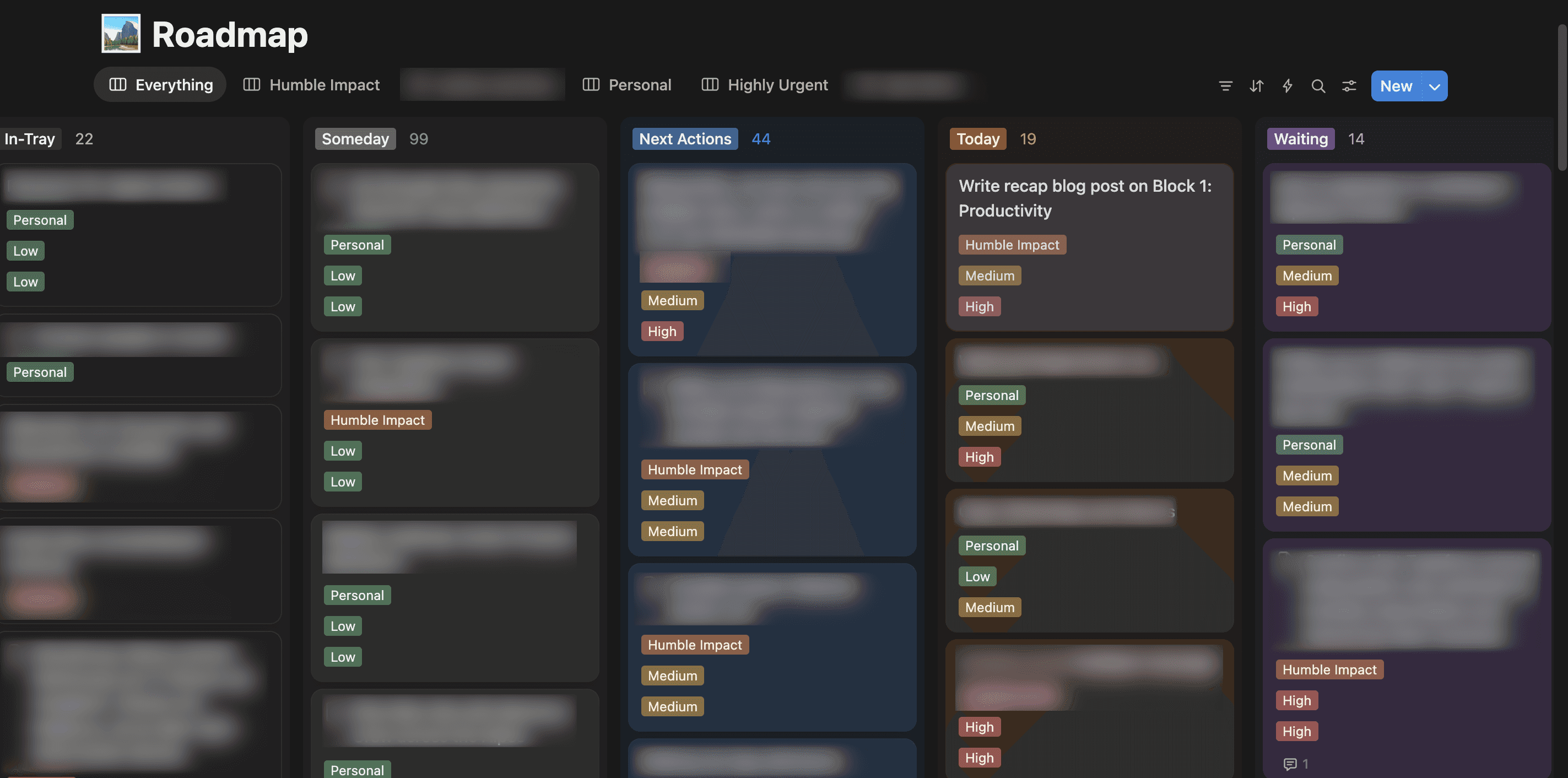
Both of us completed our quest to create and utilize a complete, high-quality action board of our tasks. We used Notion to create a Roadmap that lists everything; and by everything, we mean everything. For the first time in our lives, we felt we had an inventory of all the small and big things that are lying right in front of us, and it feels great. No more disturbing alarms with urgent reminders in the middle of the day or remembering that we need to do this one really important thing right before sleep. While we're still not perfect in the application of the ‘Getting Things Done’ methodology (more on that in 3 | Book), we have definitely benefited from starting to apply it in our daily lives.
Below is an example screenshot of my roadmap, built on Notion:
Status
In-Tray: Unorganized actions that have come in, for example a new idea, and still need to be sorted
Someday: All actions that have been defined and that I'd like to do eventually, but are not relevant immediately
Next Actions: Actions that will be tackled next, once Today's actions have been cleared
Today: Actions highly relevant to today. I personally use the definition a bit loosely; the actions can be done over several days as well
Waiting: Actions that have been done, but require input from another person that is outside my control at this moment in time
Segments
Personal: Actions related to my non-work life (for example "Read article shared by friend", with a link in the comments of the particular card)
Humble Impact: Actions related to my work related to Humble Impact
Other work segments (blurred): Same as Humble Impact
Categories
Importance Low, Medium High
Urgency: Low, Medium, High
Board views
Notion allows you to create different board views by applying filters; for example, I have a different board view for the actions of each of the main segments I'd like to look at individually, as well as one board view for all highly urgent actions.
Best practices
Mostly inspired by the "Getting Things Done" methodology, see 3 | Book
Have one board to serve as your “external mind,” not multiple ones
Implement a periodic review of your action board, during which you clear out your “In-Tray.” This review process is critical (and one that I am still familiarizing myself with), so that you can trust your system and not rely on any additional reminder systems for urgent actions.
Don’t simply put down a general description of the task (e.g., “Taxes”); define the very next action (“Find suitable tax advisor”) that brings you closer to completing it. That way, you won’t have to spend energy trying to think of what to do next when it comes time to tackle the action.
Actions shouldn’t be so big that they stay on your board for months. Instead, break them up into manageable steps.
Within the action card itself, paste all relevant sub-actions, links, email addresses, etc.—whatever you will need later—and have it at hand when defining the action.
Note: If you would like guidance on setting up a similar Notion board, we offer personal coaching sessions; simply reach out to us via our Contact page if you are interested in learning more.
3 | Book
Title: Getting Things Done: The Art of Stress-Free Productivity
Author: David Allen
First published: 2001
Estimated time to read: ~8–10 hours (approximately 300–350 pages, depending on edition)
During our productivity block, we chose to read a book that came strongly recommended by multiple sources and is widely regarded as a gold-standard framework for channeling productive energy.
We would personally recommend this book to anyone interested in productivity and in reducing mental clutter and scattered to-do lists. It offers a thoughtful blend of philosophical perspective and practical techniques for achieving clarity and control.
One message that resonated strongly with us is that your mind is for creating ideas, not for holding them. When mental capacity is spent merely trying to remember tasks and obligations, it creates unnecessary stress and leaves little room for creativity to flourish.
Core Ideas and Takeaways - A Summary Based on Our Notes:
Getting Things Done (GTD) is a productivity methodology designed to reduce stress and increase clarity by systematically externalizing, organizing, and executing commitments. Its central promise is that when people trust their system to manage tasks and obligations, they can fully engage with the present moment and direct their energy toward what matters most.
At the core of GTD are two essential questions for every commitment: What does “done” look like? (the desired outcome) and What is the very next physical action? (the concrete step). Without clear outcomes and next actions, projects tend to generate anxiety rather than momentum.
David Allen argues that the human mind is optimized for generating ideas, not for storing them. By capturing everything into an “external mind” (lists, folders, calendars), cognitive load is reduced, allowing creativity and focus to flow more naturally. This concept aligns with “distributed cognition”: once ideas are reliably captured, more ideas can emerge.
A key operational principle is rigorous In-Tray processing. Inputs should be handled top to bottom in whatever list format you are using, without priority scanning, and organized until the In-Tray is empty. “Zero In-Tray” does not mean everything is completed—it means everything has been clarified and placed into a trusted category.
GTD relies on maintaining clearly separated lists, including:
Projects (desired outcomes requiring multiple steps)
Next Actions (the very next executable tasks), segmented by In-Tray, Someday/Maybe, Next Actions / Today
Waiting For (delegated items)
Calendar (time-specific actions)
Reference material not necessarily linked to any specific action
The system emphasizes efficiency without conceding meaning: if something is meaningful, maximize return on energy; if it merely needs to be done, do it quickly. The “two-minute rule” supports this by encouraging immediate action on small tasks, rather than placing them on the action board.
Allen highlights that stress and guilt do not stem from having too much to do, but from broken agreements with oneself. These can be resolved in only three ways: don’t make the agreement, complete it, or renegotiate it. A trusted system makes commitments visible and manageable, reducing unconscious pressure.
Regular review is critical. Each project should always have at least one clearly defined next action. Reviewing lists ensures that what you are not doing feels just as acceptable as what you are doing, enabling presence and confidence.
Ultimately, GTD aims to remove barriers to the natural flow of creative energy. By mastering the mundane, for example organizing tasks, closing loops, and maintaining clarity, people create the conditions for higher-level thinking, inspiration, and purposeful action.
4 | Routine
We each defined our own personal daily routine for this block on productivity; below is a brief recap of mine:
No time spent on reels or similar short-form videos
This routine had a profound effect on my overall productivity, while not being very hard to uphold after a few days. I suddenly freed up immense time for activities such as going to the gym, reading, relaxing, or working on something meaningful, simply by not being glued to a small screen displaying content that I would forget minutes later. It has also had a great effect on my well-being by introducing fewer comparisons to my life and less content that might emotionally trigger me. I plan to upkeep this routine beyond this month.
Complete three tasks from the action board
I found it challenging to maintain this routine on a daily basis, partly because some actions naturally take more time than others. I therefore decided to adapt the routine by focusing on reviewing the day’s actions each day, a practice I am still getting used to. It has been valuable to sit down with a clear view of what needs to be done next, rather than having to think it through from scratch each time.
Read the selected book for 30 minutes
This has become one of my favorite routines, and I fully intend to continue it in the coming months. A major turning point for me was starting my mornings with a daily walk to the local café, or simply sitting wherever I am in the morning with a pot of tea or coffee and a book.
Since implementing this routine, I have been flying through multiple books, whereas before it had been a challenge to stick to completing non-fiction books, and I have noticed three things in particular:
I found it more enjoyable than immediately going behind a screen to work
I absorb the content much better first thing in the morning
It has a noticeably inspiring effect on the rest of my day
I highly recommend trying a 30-minute reading routine for anyone who wants to read more but struggles at the moment. If time feels scarce, consider going to bed a little earlier and waking up slightly earlier to give yourself this small moment of joy each morning, if that is possible given your current circumstances.
Final Thoughts
In summary, Block 1 | Productivity has had a truly tangible effect on both our overall well-being, particularly in terms of reducing feelings of stress or being overwhelmed. Having one system to work from, and a routine that helps implement this system, has helped us gain more mental freedom, clarity, and peace of mind. We look forward to the next block of our twelvetwenty journey, which focuses on mindfulness.


Be part of the twelvetwenty journey.
Sign up for our newsletter and follow us on LinkedIn below.